

Travel - Dubai and Abu Dhabi
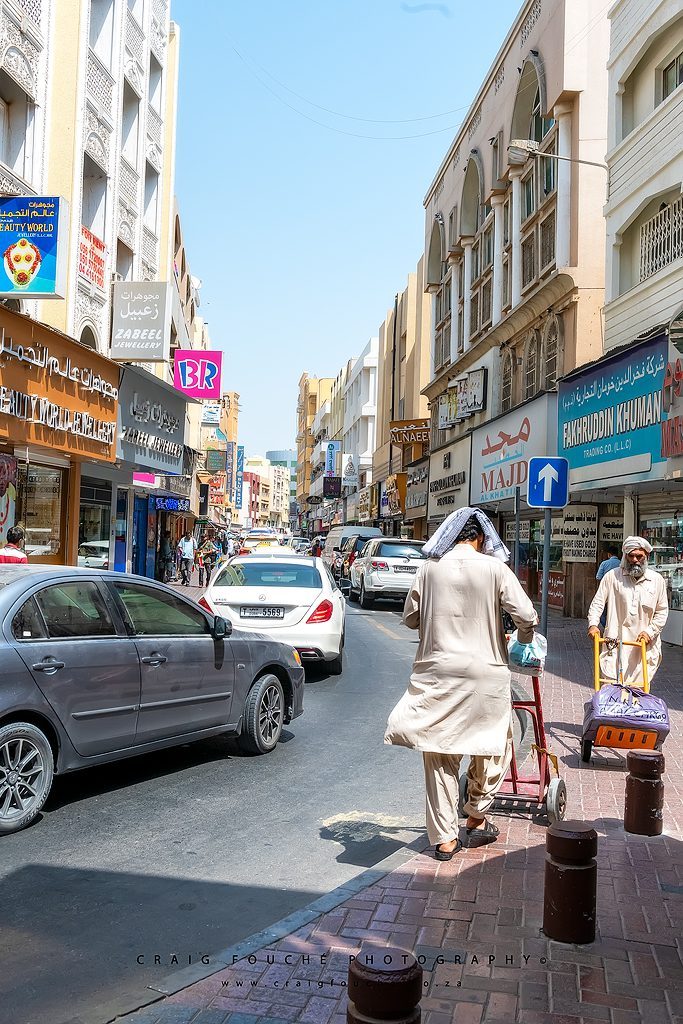
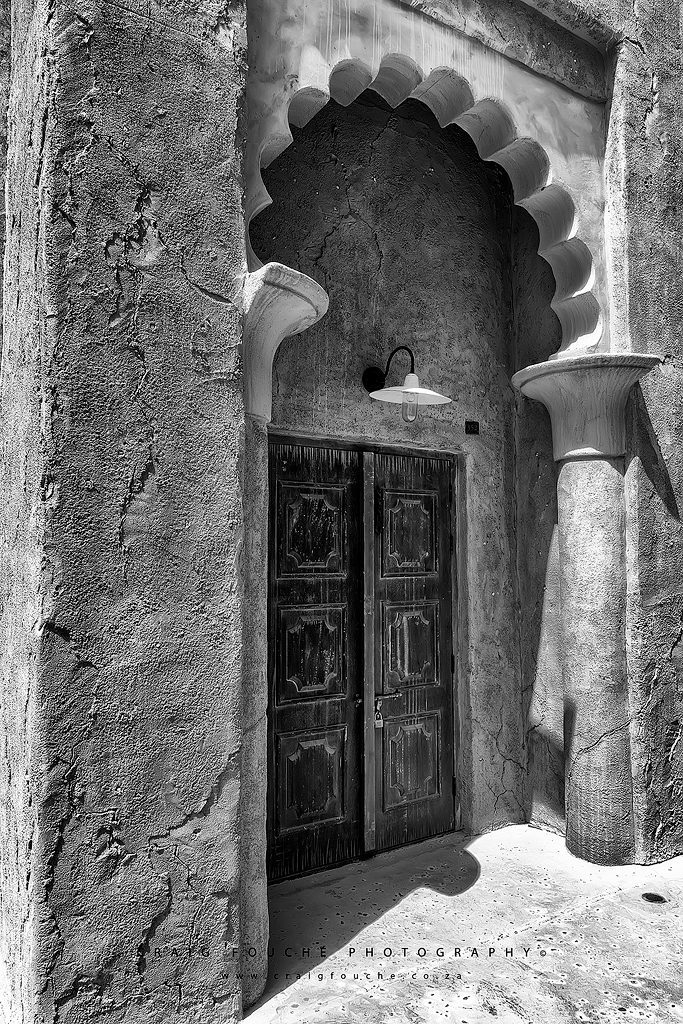
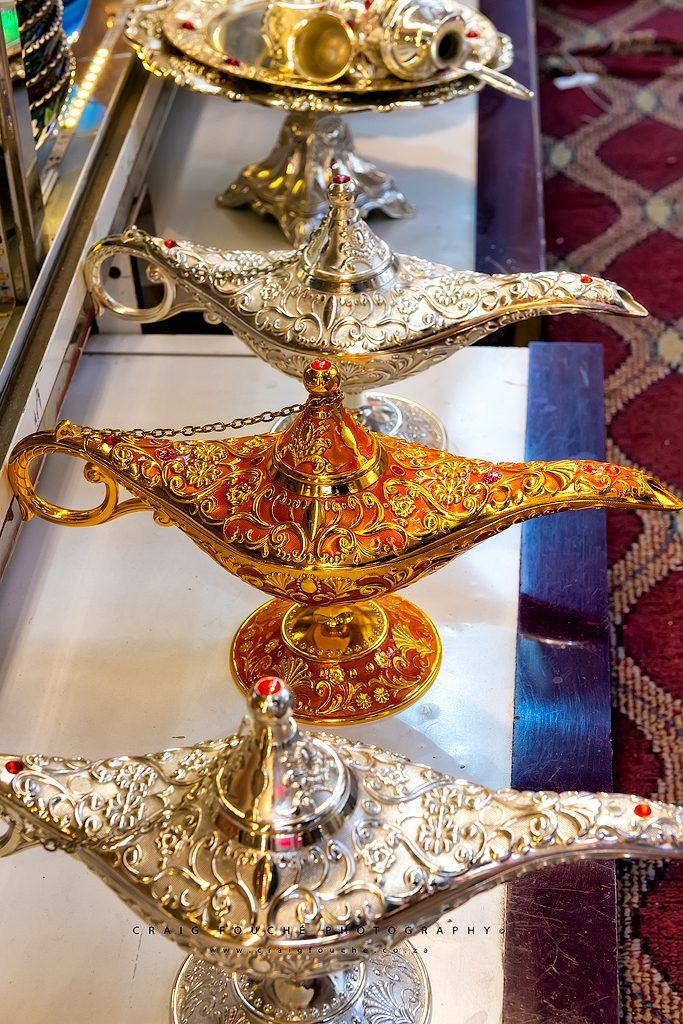
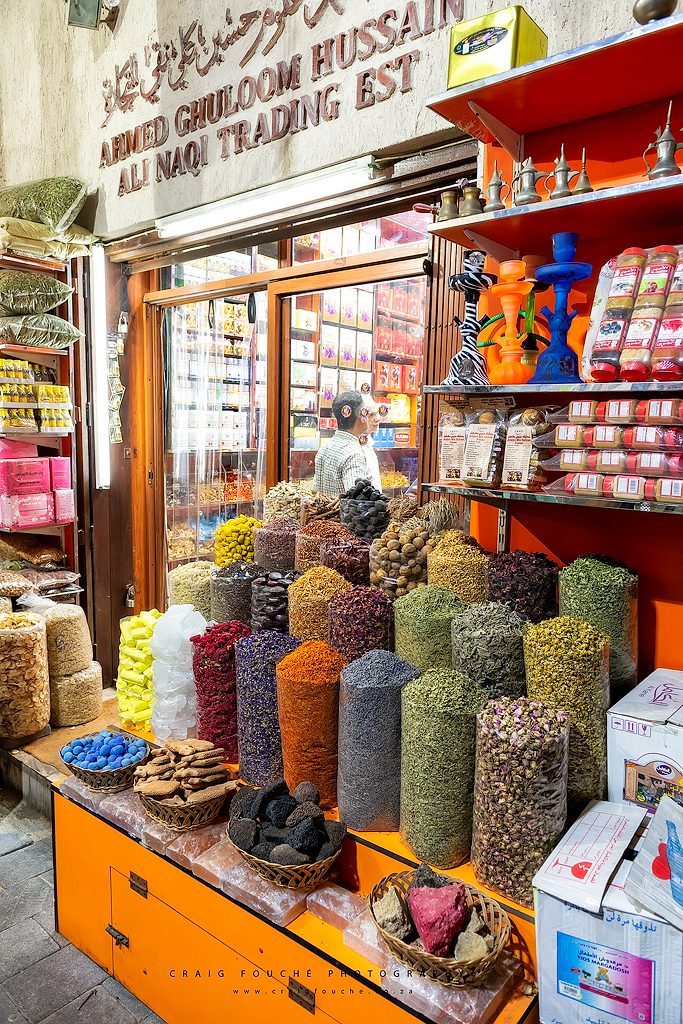
I spent a week in Dubai, travelled to Sharjah and Abu Dhabi, UAE with good friends en route home from an Oil & Gas contract and used this opportunity to capture these inspiring travel and architectural images of the modern city of Dubai and Abu Dhabi.
DUBAI
Dubai is the largest and most populous city in the United Arab Emirates and the capital of the Emirate of Dubai. There are in fact seven emirates, and it is quite easy to assume that Dubai is the capital of the UAE.
Located on the southeast coast of the Persian Gulf, Dubai is a global city and the business hub of the Middle East. It is also a major global transport hub for passengers and cargo. Oil revenue helped accelerate the development of the city, which was already a major mercantile hub. Today, less than 5% of the emirate’s revenue comes from oil. A centre for regional and international trade since the early 20th century, Dubai’s economy relies on revenues from trade, tourism, aviation, real estate, and financial services.
Dubai has attracted the attention of the world through large construction projects, opulent hotels and hosting major sports tournaments.
Many theories have been proposed as to the origin of the word “Dubai”. One theory suggests the word was used to describe the souq, which was similar to the souq in Ba. An Arabic proverb says “Daba Dubai”, meaning “They came with a lot of money.”
Dubai is thought to have been established as a fishing village in the early 18th century and was, by 1822, a town of some 700–800 members of the Bani Yas tribe and subject to the rule of Sheikh Tahnun bin Shakhbut of Abu Dhabi.
In 1833, following tribal feuding, members of the Al Bu Falasah tribe seceded from Abu Dhabi and established themselves in Dubai. The exodus from Abu Dhabi was led by Obeid bin Saeed and Maktoum bin Butti, who became joint leaders of Dubai until Ubaid died in 1836, leaving Maktum to establish the Maktoum dynasty.
In 1901, Maktoum bin Hasher Al Maktoum established Dubai as a free port with no taxation on imports or exports and also gave merchants parcels of land and guarantees of protection and tolerance. These policies saw a movement of merchants.
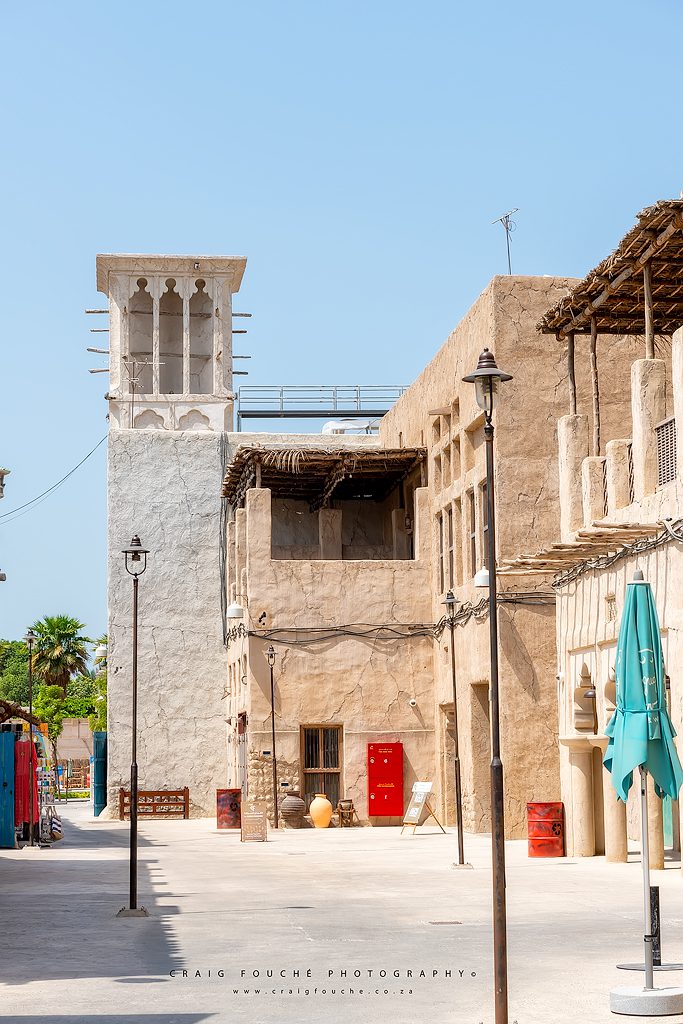
Wind Towers, Bastakia Quarter, Bur Dubai, Dubai, UAE
The old Bastakia Quarter in Bur Dubai is one of the city’s picturesque heritage sites, where old collides with the new. Located between Dubai Creek and the Bur Dubai District, it was built in the late 19th century by Persian merchants attracted to its relaxed trade tarrifs, and takes its name from the town in the south of Iran – Bastak. It became home to local Arab tribes and the earliest foreign settlers, and can be named as an area which started the city’s economic and trade related growth. The area has been declared a conservation area, and the narrow alleys and streets are pedestrianised. Many of the restored buildings here feature wind towers, an early but effective form of airconditioning. My are private homes and some are open to the public. With all of the modern beauty that Dubai has to offer, with its skyscrapers and luxury hotels, The Bastakia Quarter sits among all of these engineering marvels as one of the oldest residential areas in Dubai.
ABU DHABI
Meaning ‘Father of the Gazelle’ in Arabic, Abu Dhabi was founded when a young antelope led a wandering tribe to freshwater, on an island with no more than 300 palm (‘barasti’) huts, a few coral buildings and the Ruler’s fort. This simple island settlement has since been transformed into the modern, cosmopolitan city of Abu Dhabi and the high-rise capital of the United Arab Emirates.
A tour of the UAE capital usually takes in everything from the evolving skyline to sandy shores and iconic buildings. Most tour operators will take you for a stroll along the Corniche, which will give you a glimpse of everyday Abu Dhabi life and the chance to savour some picturesque scenes. Tours also usually include the Sheikh Zayed Grand Mosque, the Saadiyat Island Cultural District Exhibition at Emirates Palace and the Heritage Village.

Sheik Zayed Grand Mosque
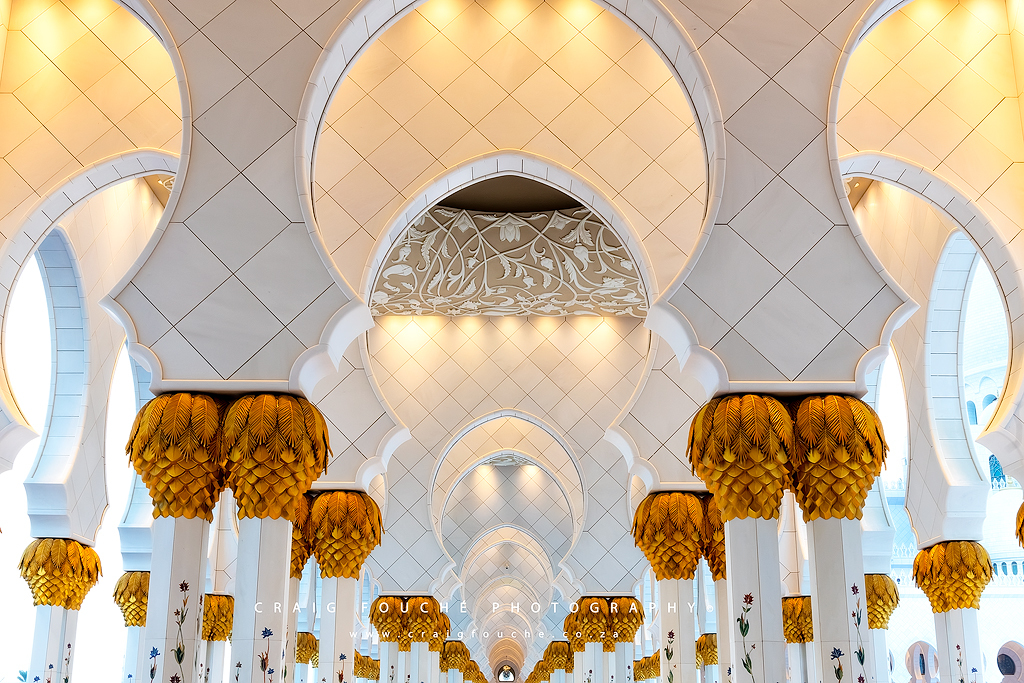
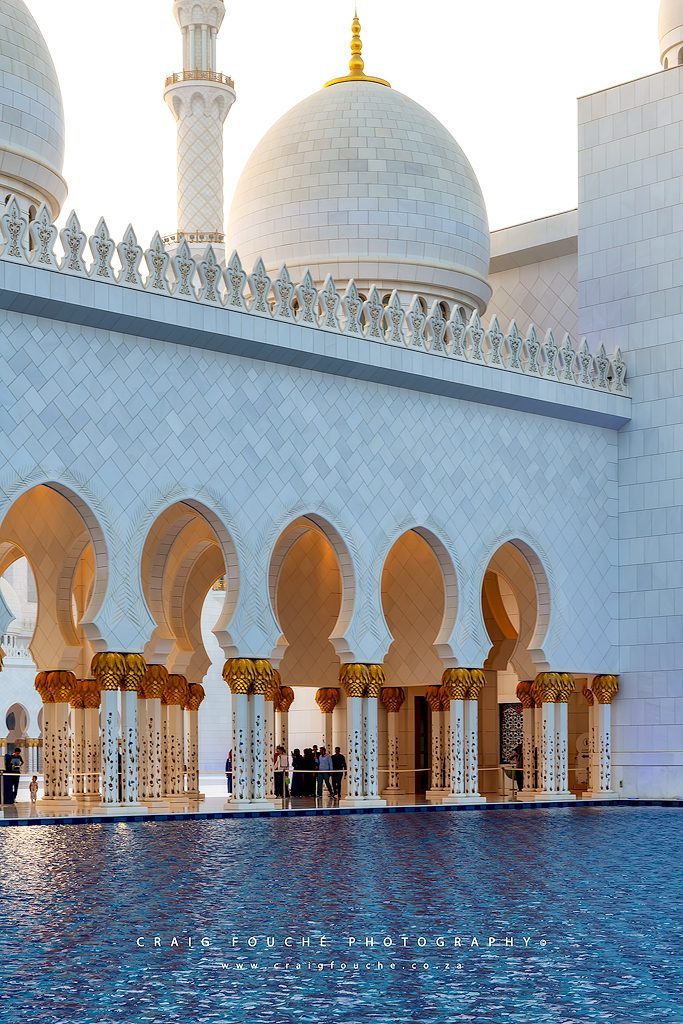
Sheikh Zayed Grand Mosque, Abu Dhabi, UAE
This architectural work of art is one of the World’s largest mosques, and the only one that captures unique interactions between Islam and world cultures. With a capacity for an astonishing 40 000 worshippers. It features 82 domes, over a 1 000 columns, 24-carat gold gilded chandeliers and the World’s largest hand-knotted carpet. The main prayer hall is dominated by one of the World’s largest chandeliers – 10 meters in diameter, 15 meters in height and weighing 12 tons. The mosque’s first ceremony was the funeral of its namesake, Sheikh Zayed, who is buried at the site.

Sheik Zayed Grand Mosque
Reflective pools surround the mosque, amplifying its beauty. The striking white and gold colours shining in the sun are transformed at night by a unique lightning system which reflects the phases of the moon.
Unlike other mosques in Abu Dhabi, the Sheikh Zayed Grand Mosque is open daily to visitors, except on Friday morning, which is for worshippers only. The opening hours are 09h00 to 22h00 (last entry at 21h30) daily and 16h30 to 22h00 on Fridays. During the Holy Month of Ramadan, the mosque is open daily, except Friday, from 09h00 to 14h00 with last entry at 13h30.
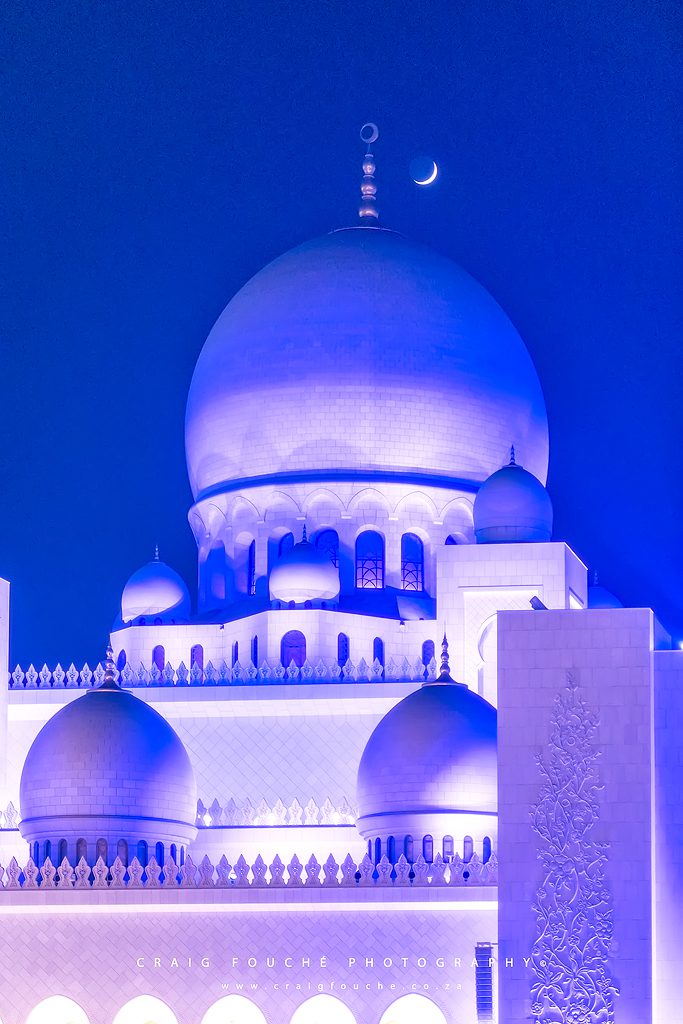
Sheik Zayed Grand Mosque
Complimentary one hour guided tours run daily at 10h00, 11h00 and 17h00. Friday times are 17h00 and 19h00 and Saturday times are 10h00, 11h00, 14h00, 17h00 and 19h00.
It highly recommended that the visitor finishes sight-seeing or shopping for the day then take the 17h00 guided tour. Get to the mosque around 16h30 – a wonderful time to take photos – to wind down and chill out for 20 minutes in the lovely afternoon breeze before the tour. In my case, I went along with my friend Dirk, a guided tour is not necessary, but I am sure it would be more informative.
Information About The Mosque
The Grand Mosque was constructed between 1996 and 2007. It was designed by Syrian architect Yousef Abdelky. The building complex measures approximately 290m by 420 m, covering an area of more than 12 hectares, excluding exterior landscaping and vehicle parking. The main axis of the building is rotated about 11° south of true west, aligning it in the direction of the Kaaba in Mecca, Saudi Arabia. Dimensions and alignment are estimated from satellite images.
The project was launched by the late president of the United Arab Emirates, Sheikh Zayed bin Sultan Al Nahyan, who wanted to establish a structure that would unite the cultural diversity of the Islamic world with the historical and modern values of architecture and art. His final resting place is located on the grounds adjacent to the complex.
Sheikh Zayed Grand Mosque Center (SZGMC) offices are located in the west minarets. SZGMC manages the day-to-day operations and serves as a centre of learning and discovery through its educational cultural activities and visitor programs.
The library, located in the northeast minaret, serves the community with classic books and publications addressing a range of Islamic subjects: sciences, civilization, calligraphy, the arts, and coins, including some rare publications dating back more than 200 years. The collection comprises material in a broad range of languages, including Arabic, English, French, Italian, Spanish, German, and Korean.
For two years running, the mosque was voted the world’s second favourite landmark by TripAdvisor.
Design And Construction
The design of the Sheikh Zayed Mosque has been inspired by Persian, Mughal, and the Alexandrian Mosque of Abu al-Abbas al-Mursi Mosque in Egypt, also the Indo-Islamic mosque architecture, particularly the Badshahi Mosque in Lahore, Pakistan being direct influences. The dome layout and floorplan of the mosque was inspired by the Badshahi Mosque. Its archways are quintessentially Moorish, and its minarets classically Arab.
Under lead contractor Impregilo (Italy), more than 3 000 workers and 38 sub-contracting companies took part in its construction. The mosque was completed under a second contract by a Joint Venture between ACC and Six Construct (part of BESIX ) between 2004 and 2007. Natural materials were chosen for much of its design and construction due to their long-lasting qualities, including marble stone, gold, semi-precious stones, crystals and ceramics. Artisans and materials came from many countries including India, Italy, Germany, Egypt, Turkey, Morocco, Pakistan, Malaysia, Iran, China, United Kingdom, New Zealand, North Macedonia and the UAE.
Dimensions And Statistics
The mosque is large enough to accommodate over 40 000 worshippers, while the main prayer hall can hold over 7 000. There are two smaller prayer halls, with a capacity of 1 500 each, one of which is the women’s prayer hall.
There are four minarets on the four corners of the courtyard which rise about 107 m in height. The courtyard, with its floral design, measures about 17 000 m² and is considered to be the largest example of marble mosaic in the world.
Sivec from Prilep, North Macedonia was used on the external cladding, 115 119 m² of cladding has been used on the mosque, including the minarets.
Lasa from Laas, South Tyrol, Italy was used in the internal elevations
Makrana from Makrana, India was used in the annexes and offices
Acquabianca and Bianco P from Italy
East White and Ming Green from China
To compare, the King Faisal Mosque of Sharjah, formerly the largest mosque in Sharjah and country, measures 10 000–12 000 m².
Key Architectural Features
The Sheikh Zayed Grand Mosque has many special and unique elements: The carpet in the main prayer hall is considered to be the world’s largest carpet made by Iran’s Carpet Company and designed by Iranian artist Ali Khaliqi. This carpet measures 5 627 m² and was made by around 1 200-1 300 carpet knotters. The weight of this carpet is 35 ton and is predominantly made from wool (originating from New Zealand and Iran). There are 2 268 000 000 knots within the carpet and it took approximately two years to complete.
The Sheikh Zayed Grand Mosque has seven imported chandeliers from the company Faustig in Munich, Germany that incorporates millions of Swarovski crystals. The largest chandelier is the second largest known chandelier inside a mosque, the third-largest in the world, and has a 10 m diameter and a 15 m height.
The pools along the arcades reflect the mosque’s columns, which become illuminated at night. The unique lighting system was designed by lighting architects Speirs and Major Associates to reflect the phases of the moon. Beautiful bluish grey clouds are projected in lights onto the external walls and get brighter and darker according to the phase of the moon.
The 96 columns in the main prayer hall are clad with marble and inlaid with mother of pearl, one of the few places where one can see this craftsmanship.
The 99 names (qualities or attributes) of God (Allah) are featured on the Qibla wall in traditional Kufic calligraphy, designed by the prominent UAE calligrapher — Mohammed Mandi Al Tamimi. The Qibla wall also features subtle fibre-optic lighting, which is integrated as part of the organic design.
In total, three calligraphy styles — Naskhi, Thuluth and Kufic — are used throughout the mosque and were drafted by Mohammed Mandi Al Tamimi of the UAE, Farouk Haddad of Syria and Mohammed Allam of Jordan.
Be sure to spot the calligraphy encircling the hollows of the domes, etched with verses from the Quran and painted with gold leaves in An-Naskh lettering.
Visiting The Mosque
The mosque has a few shops and restaurants on the site. Be sure on arrival to pass through the visitor centre where after clearing security you will be allowed to proceed through underground passages to view the mosque. Only worshippers are allowed to proceed directly to the mosque. Entry fee is free and visitors are also required to park in a designated underground parking, which is great in the blazing summer months.
Any time of day is a good time to visit the mosque, however due to the heat you’re best visiting early morning or late evening. Also, if you’re into your photography then you might want to visit at sunset or just before sunset during golden hour as the photos I have seen from this time make the building look even more beautiful as the sun is shining off of it!
This is obviously a Muslim site, you do need to cover up and understandably they are very strict with the dress code. They do however provide women with a black abaya free of charge which they have in a few different sizes. Please double check that abayas are available on the Grand Mosque website before you visit and ensure your own outfit is appropriate and includes a headscarf. For gents, long shorts over the knees and a a respectable short sleeve lounge shirt is acceptable.
Report this ad
For more information on the dress code, see the Mosque Manners section on the official website.
If you are visiting during a bright sunny time of the day, you’ll probably have your sunglasses on you anywhere as you’re in the UAE, but make sure you do pack them as the white building and the strong sun can make it practically blinding!
Free guided tours are available at various times during the day depending on the day. The tours are offered in English and Arabic and children are welcome. You can find the tour times on the official Grand Mosque website.
Acknowledgements
Wikipedia, Visit Abu Dhabi
Gallery
All my images are available for purchase as prints. Digital images can be used under a license agreement. Should you wish to purchase or license my images, please click here for more information, so I can assist you with your needs.
Click on the images and select the appropriate buttons to view an enlarged single image with titles in full screen.





0 Comments