Astro
Astrophotography
Starlight | Time | Infinity
Infinite Skies, Infinite Wonder
Craig Fouché Photography explores the Southern Hemisphere night sky through long-exposure astrophotography, revealing the Milky Way, constellations and celestial landscapes from some of South Africa’s darkest locations. Astrophotography is the art and science of capturing the night sky in all its grandeur, from the delicate shimmer of distant stars to the sweeping arc of the Milky Way. Unlike most other forms of photography, it demands not only technical mastery but also patience, precision, and a deep reverence for the cosmos. The resulting images are more than documentation—they are visual testimonies to the immensity, mystery, and beauty of our universe.
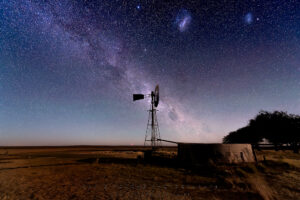
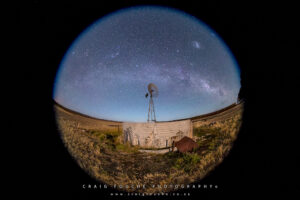
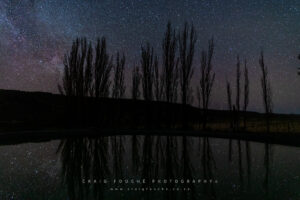
At its heart, astrophotography is about light—capturing photons that have travelled thousands, millions, or even billions of years to reach the Earth. To do this effectively, photographers rely on wide, fast lenses capable of gathering the maximum light possible. Lenses with apertures of f/1.4 to f/2.8 are often preferred for their ability to reveal subtle constellations, the dense star fields of the Milky Way, and the faint glow of distant nebulae. Even with the most sophisticated equipment, timing and location are paramount. To achieve truly awe-inspiring images, one must seek out skies free of light pollution, ideally in remote or sparsely inhabited regions where the heavens can be seen in all their glory. In South Africa, locations such as the Karoo and Cederberg offer some of the most spectacular vantage points, where windmills, rock formations, and natural landscapes can be elegantly composed beneath the Milky Way.
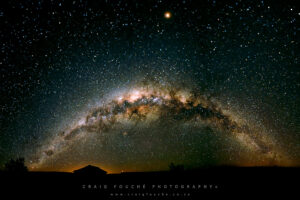
The Milky Way itself is a barred spiral galaxy spanning approximately 100,000 to 120,000 light-years and containing hundreds of billions of stars, along with countless planets and interstellar phenomena. Observing it from Earth, the Milky Way presents as a luminous, hazy band stretching across the sky, its core brightest in the direction of Sagittarius. Capturing the full breadth of this arc often requires stitching together multiple images into panoramic compositions, creating immersive representations of our galactic home.
Astrophotography poses unique challenges. The low surface brightness of celestial bodies means that even minimal light pollution can diminish visibility and obscure delicate detail. Photographers must carefully plan sessions around the lunar cycle, ideally shooting during New Moon phases or when the Moon is below the horizon. Knowledge of constellations, star motions, and seasonal sky changes is equally essential, allowing the photographer to predict where celestial phenomena will occur and how they will align with terrestrial elements in the frame.
Long exposures, precise tracking, and careful post-processing are fundamental to this craft. Stars must be sharp, yet the Earth’s rotation causes apparent motion, necessitating techniques such as tracking mounts or image stacking to produce crisp, noise-free images. Advanced post-processing then allows subtle colour, contrast, and texture to emerge, transforming raw exposures into luminous, almost tangible renderings of the night sky.
Astrophotography is as much about inspiration as it is about technique. It encourages a sense of humility and wonder, reminding us of our place within a vast universe. It is a genre where artistic vision and scientific observation intersect—a place where creativity meets precision, and the night sky becomes a canvas for human imagination. Every image captured is a dialogue with the cosmos, an attempt to interpret its silent, timeless beauty, and a record of a fleeting moment in which Earth, sky, and photographer align.
Ultimately, astrophotography celebrates both the universe and the artistry of seeing. It transforms the invisible into the visible, the incomprehensible into the poetic, and allows us to share, through light and shadow, the grandeur of Creation as few can experience it directly.
Explore the Collection
Discover the Fine Art Digital Collection — a curated body of work that invites viewers and collectors alike to experience the grandeur of Africa’s landscapes through the expansive lens of digital format.
ASTROPHOTOGRAPHY GALLERY


MORE ON DIGITAL LANDSCAPES

Aerial

Architecture

Cityscapes

Industrial

Infrared

Macro

Seascapes
MORE ON DIGITAL PORTRAITS

Portraiture
MORE ON DIGITAL SPORT

Sport
MORE ON DIGITAL BLACK & WHITE

Black & White
MORE ON DIGITAL TRAVEL & WILDLIFE

Travel

Wildlife