

How To Fly With Photography Gear
So, you’re off to photograph your dream destination and you have to travel there by plane. My condolences. Things used to be easier and simpler. Today traveling with cameras on planes results in silly, idiotic, restricting, and inconveniencing encounters with various people vested with too much authority and too little common sense, who simply cant think out of the box when it comes to photographic gear. This is definitely something that needs to be addressed by all airlines. It is my hope that this blog, on how to fly with photography gear will help, as I am experiencing these issues first hand. I have researched various websites to obtain this information.
What is one of your worst nightmares as a national or international professional photographer? Losing your luggage. It happens all the time, unfortunately. Not just one airline in particular; almost all airline companies utterly fail in customer support when it comes to understanding professional photographers and the importance or value of their equipment or job.
I’m not going to tackle airline atrocities, Johannesburg Airport is well known for luggage theft, and more recently two people stowed away on a BA flight to London. Instead, I’m going to concentrate on just one thing: carry-on weight.
Under no circumstances am I ever ever ever going to check my camera or computer gear. It’s like waving good-bye to it as I feel like I’d never see it again. If I have to check my camera gear, then I’m not going! Most airlines allow you one piece of carry-on luggage such as a roller-board suitcase and a personal item such as a backpack, briefcase or ladies handbag. For me that means a backpack.
I have taken some time to review most of the airlines that depart from South Africa to international destinations, to see where we stand on how to fly with photography gear; in general, it is not very clear when it comes to photography gear. It has everything to do with weight or size! On the odd occasion, it actually mentions what size camera can be taken, and nowhere do they say we can be exempt from having our gear with us. There are options on some airlines to book an extra seat, where you gear can travel as a passenger next to you!
What International Airlines Say About Carry-On
Air France
Air France permits one cabin bag plus one accessory (handbag, laptop, or camera) with a combined weight of up to 12 kg. Dimensions must not exceed 55 × 35 × 25 cm.
| Allowance | Details |
|---|---|
| Weight | 12 kg combined |
| Dimensions | 55 × 35 × 25 cm |
| Accessory | Handbag, laptop, or camera |
Source: Air France Baggage Policy
Air New Zealand
Economy passengers may carry one cabin bag up to 7 kg. Premium Economy and Business Class passengers, as well as elite frequent flyers, may carry two bags with a combined weight of 14 kg (one item up to 10 kg).
| Class | Allowance |
|---|---|
| Economy | 1 bag, 7 kg |
| Premium Economy | 2 bags, 14 kg total |
| Business | 2 bags, 14 kg total |
Source: Air New Zealand Baggage Policy
Cathay Pacific
Cathay Pacific allows one cabin bag per passenger, with dimensions not exceeding 56 × 36 × 23 cm. Weight limits vary by class: 15 kg in First, 10 kg in Business, and 7 kg in Economy.
| Class | Weight |
|---|---|
| First Class | 15 kg |
| Business Class | 10 kg |
| Economy Class | 7 kg |
Source: Cathay Pacific Baggage Policy
Croatia Airlines
Economy passengers may carry one cabin bag up to 8 kg. Business Class passengers may carry two pieces, each up to 8 kg. Dimensions must not exceed 115 cm total.
| Class | Allowance |
|---|---|
| Economy | 1 bag, 8 kg |
| Business | 2 bags, 8 kg each |
Note: Policies were current in 2015. Croatia Airlines may have changed or merged since.
Emirates
Emirates allows two pieces in First and Business Class (briefcase plus handbag or garment bag), each up to 7 kg. Economy passengers may carry one piece up to 7 kg.
| Class | Allowance |
|---|---|
| First/Business | 2 pieces, 7 kg each |
| Economy | 1 piece, 7 kg |
Source: Emirates Baggage Policy
Etihad
Etihad permits two cabin bags totaling 12 kg in First and Business Class, one bag up to 7 kg in Economy, and one bag up to 5 kg for infants.
| Class | Allowance |
|---|---|
| First | 2 bags, 12 kg total |
| Business | 2 bags, 12 kg total |
| Economy | 1 bag, 7 kg |
| Infant | 1 bag, 5 kg |
Source: Etihad Baggage Policy
Icelandair
Saga and Economy Comfort passengers may carry two cabin bags plus one personal item, each bag up to 10 kg. Economy passengers may carry one bag up to 10 kg.
| Class | Allowance |
|---|---|
| Saga | 2 bags, 10 kg each |
| Economy Comfort | 2 bags, 10 kg each |
| Economy | 1 bag, 10 kg |
Source: Icelandair Baggage Policy
Kenya Airways
Premier World passengers may carry two cabin bags plus one accessory, total weight 12 kg. Economy passengers may carry one cabin bag plus one accessory, total weight 12 kg.
| Class | Allowance |
|---|---|
| Premier World | 2 bags + 1 accessory, 12 kg total |
| Economy | 1 bag + 1 accessory, 12 kg total |
Source: Kenya Airways Baggage Policy
KLM
KLM allows one cabin bag in Economy Class and two in Business Class. Dimensions must not exceed 55 × 35 × 25 cm for the main bag, with a smaller second bag permitted in Business. Weight limits are 12 kg in Economy and 18 kg in Business.
| Class | Allowance |
|---|---|
| Economy | 1 bag, 12 kg |
| Business | 2 bags, 18 kg total |
Source: KLM Baggage Policy
Lufthansa
Lufthansa permits one cabin bag in Economy and Premium Economy, and two in Business and First Class. Each bag may weigh up to 8 kg. Dimensions are limited to 55 × 40 × 23 cm, with garment bags allowed up to 57 × 54 × 15 cm.
| Class | Allowance |
|---|---|
| Economy | 1 bag, 8 kg |
| Premium Economy | 1 bag, 8 kg |
| Business | 2 bags, 8 kg each |
| First | 2 bags, 8 kg each |
Source: Lufthansa Baggage Policy
Qantas
Qantas cabin baggage allowances vary by class. Economy passengers may carry one bag up to 7 kg, while Business and First Class passengers may carry two bags with a combined weight of 14 kg. Enhanced security measures apply on flights to the UK and US.
| Class | Allowance |
|---|---|
| Economy | 1 bag, 7 kg |
| Business | 2 bags, 14 kg total |
| First | 2 bags, 14 kg total |
Source: Qantas Baggage Policy
Qatar Airways
Qatar Airways permits two cabin bags in First and Business Class, not exceeding a combined weight of 15 kg. Economy passengers may carry one bag up to 7 kg. Maximum dimensions are 50 × 37 × 25 cm.
| Class | Allowance |
|---|---|
| First | 2 bags, 15 kg total |
| Business | 2 bags, 15 kg total |
| Economy | 1 bag, 7 kg |
Source: Qatar Airways Baggage Policy
Swiss
Swiss allows one cabin bag up to 8 kg in Economy, and two bags up to 8 kg each in Business and First Class. Dimensions must not exceed 55 × 40 × 23 cm. A foldable garment bag up to 57 × 54 × 15 cm is also permitted.
| Class | Allowance |
|---|---|
| Economy | 1 bag, 8 kg |
| Business | 2 bags, 8 kg each |
| First | 2 bags, 8 kg each |
Source: Swiss Baggage Policy
TAM Linhas Aéreas
TAM Linhas Aéreas (later merged into LATAM) permitted one cabin bag per passenger, with dimensions and weight limits similar to LAN regulations. Policies were current in 2015 and may have changed since.
| Class | Allowance |
|---|---|
| Economy | 1 bag, approx. 8 kg |
| Business | 2 bags, approx. 8 kg each |
Note: TAM merged into LATAM Airlines Group. Policies may differ today.
Thai Airways
Thai Airways permits one cabin bag in Economy Class up to 7 kg, and two cabin bags in Business and First Class, each up to 7 kg. Dimensions must not exceed 56 × 45 × 25 cm.
| Class | Allowance |
|---|---|
| Economy | 1 bag, 7 kg |
| Business | 2 bags, 7 kg each |
| First | 2 bags, 7 kg each |
Source: Thai Airways Baggage Policy
Turkish Airlines
Turkish Airlines allows one cabin bag in Economy Class up to 8 kg, and two cabin bags in Business Class, each up to 8 kg. Dimensions must not exceed 55 × 40 × 23 cm.
| Class | Allowance |
|---|---|
| Economy | 1 bag, 8 kg |
| Business | 2 bags, 8 kg each |
Source: Turkish Airlines Baggage Policy
United Airlines
United Airlines permits one cabin bag plus one personal item in all classes. The cabin bag must fit in the overhead bin and the personal item under the seat. Weight limits are not strictly enforced, but dimensions must not exceed 56 × 35 × 22 cm.
| Allowance | Details |
|---|---|
| Cabin Bag | 1 piece, 56 × 35 × 22 cm |
| Personal Item | 1 piece, fits under seat |
Source: United Airlines Baggage Policy
Virgin Atlantic
Virgin Atlantic allows one cabin bag in Economy and Premium Economy up to 10 kg, and two cabin bags in Upper Class, each up to 12 kg. Dimensions must not exceed 56 × 36 × 23 cm.
| Class | Allowance |
|---|---|
| Economy | 1 bag, 10 kg |
| Premium Economy | 1 bag, 10 kg |
| Upper Class | 2 bags, 12 kg each |
Source: Virgin Atlantic Baggage Policy
What Southern African Airlines Say About Carry-On
South African Airways (SAA)
South African Airways allows one cabin bag per passenger in Economy Class, up to 8 kg, and two cabin bags in Business Class, each up to 8 kg. Dimensions must not exceed 56 × 36 × 23 cm.
| Class | Allowance |
|---|---|
| Economy | 1 bag, 8 kg |
| Business | 2 bags, 8 kg each |
Source: South African Airways Baggage Policy
Mango Airlines
Mango permitted one cabin bag up to 7 kg per passenger, with dimensions not exceeding 56 × 36 × 23 cm. A small personal item such as a handbag or laptop bag was also allowed. Note: Mango ceased operations in 2021, but policies are included here for historical reference.
| Allowance | Details |
|---|---|
| Weight | 1 bag, 7 kg |
| Dimensions | 56 × 36 × 23 cm |
| Accessory | Handbag or laptop bag |
Note: Mango Airlines is no longer operational.
Kulula
Kulula allowed one cabin bag per passenger up to 7 kg, with maximum dimensions of 56 × 36 × 23 cm. A small personal item such as a handbag or laptop bag was also permitted.
| Allowance | Details |
|---|---|
| Weight | 1 bag, 7 kg |
| Dimensions | 56 × 36 × 23 cm |
| Accessory | Handbag or laptop bag |
Source: Kulula Baggage Policy
Comair (British Airways South Africa)
Comair, operating British Airways flights in South Africa, permitted one cabin bag up to 7 kg in Economy Class and two cabin bags in Business Class. Dimensions were limited to 56 × 36 × 23 cm.
| Class | Allowance |
|---|---|
| Economy | 1 bag, 7 kg |
| Business | 2 bags, 7 kg each |
Note: Comair ceased operations in 2022.
Airlink
Airlink allows one cabin bag per passenger up to 8 kg, with dimensions not exceeding 56 × 36 × 23 cm. A small personal item such as a handbag or laptop bag is also permitted.
| Allowance | Details |
|---|---|
| Weight | 1 bag, 8 kg |
| Dimensions | 56 × 36 × 23 cm |
| Accessory | Handbag or laptop bag |
Source: Airlink Baggage Policy
FlySafair
FlySafair permits one cabin bag per passenger up to 7 kg, with dimensions not exceeding 56 × 36 × 23 cm. A small personal item such as a handbag or laptop bag is also allowed.
| Allowance | Details |
|---|---|
| Weight | 1 bag, 7 kg |
| Dimensions | 56 × 36 × 23 cm |
| Accessory | Handbag or laptop bag |
Source: FlySafair Baggage Policy
Air Botswana
Air Botswana allows one cabin bag per passenger up to 7 kg, with dimensions not exceeding 51 × 20 × 23 cm. A small personal item such as a handbag or laptop bag is also permitted.
| Allowance | Details |
|---|---|
| Weight | 1 bag, 7 kg |
| Dimensions | 51 × 20 × 23 cm |
| Accessory | Handbag or laptop bag |
Source: Air Botswana Baggage Policy
Air Namibia
Air Namibia permitted one cabin bag per passenger in Economy Class up to 7 kg, and two cabin bags in Business Class, each up to 10 kg. Dimensions were limited to 56 × 36 × 23 cm. Note: Air Namibia ceased operations in 2021, but policies are included here for historical reference.
| Class | Allowance |
|---|---|
| Economy | 1 bag, 7 kg |
| Business | 2 bags, 10 kg each |
Note: Air Namibia ceased operations in 2021.
Closing Thoughts
Southern African airlines generally follow similar cabin baggage rules, with allowances between 7–8 kg and dimensions around 56 × 36 × 23 cm. While some carriers like Mango and Comair are no longer operational, their policies remain part of the historical record. For photographers, the key takeaway is to always check the latest rules before flying, and plan ahead to protect your gear.
Mega Comparison Table – Cabin Baggage Allowances
| Airline | Economy | Premium Economy | Business | First | Notes |
|---|---|---|---|---|---|
| Air France | 1 bag + 1 accessory, 12 kg | — | Same as Economy | Same as Economy | Dimensions 55 × 35 × 25 cm |
| Air New Zealand | 1 bag, 7 kg | 2 bags, 14 kg total | 2 bags, 14 kg total | — | One item up to 10 kg |
| Cathay Pacific | 1 bag, 7 kg | 1 bag, 7 kg | 1 bag, 10 kg | 1 bag, 15 kg | Dimensions 56 × 36 × 23 cm |
| Croatia Airlines | 1 bag, 8 kg | — | 2 bags, 8 kg each | — | Historic policy (2015) |
| Emirates | 1 bag, 7 kg | — | 2 pieces, 7 kg each | 2 pieces, 7 kg each | Briefcase + handbag/garment bag |
| Etihad | 1 bag, 7 kg | — | 2 bags, 12 kg total | 2 bags, 12 kg total | Infants: 1 bag, 5 kg |
| Icelandair | 1 bag, 10 kg | 2 bags, 10 kg each | 2 bags, 10 kg each | — | Dimensions 55 × 40 × 20 cm |
| Kenya Airways | 1 bag + 1 accessory, 12 kg total | — | 2 bags + 1 accessory, 12 kg total | — | Extra seat option for gear |
| KLM | 1 bag, 12 kg | — | 2 bags, 18 kg total | — | Main bag 55 × 35 × 25 cm |
| Lufthansa | 1 bag, 8 kg | 1 bag, 8 kg | 2 bags, 8 kg each | 2 bags, 8 kg each | Garment bag 57 × 54 × 15 cm |
| Qantas | 1 bag, 7 kg | — | 2 bags, 14 kg total | 2 bags, 14 kg total | Extra security for UK/US flights |
| Qatar Airways | 1 bag, 7 kg | — | 2 bags, 15 kg total | 2 bags, 15 kg total | Dimensions 50 × 37 × 25 cm |
| Swiss | 1 bag, 8 kg | — | 2 bags, 8 kg each | 2 bags, 8 kg each | Garment bag 57 × 54 × 15 cm |
| TAM Linhas Aéreas | 1 bag, ~8 kg | — | 2 bags, ~8 kg each | — | Merged into LATAM |
| Thai Airways | 1 bag, 7 kg | — | 2 bags, 7 kg each | 2 bags, 7 kg each | Dimensions 56 × 45 × 25 cm |
| Turkish Airlines | 1 bag, 8 kg | — | 2 bags, 8 kg each | — | Dimensions 55 × 40 × 23 cm |
| United Airlines | 1 cabin bag + 1 personal item | — | Same as Economy | Same as Economy | Cabin bag 56 × 35 × 22 cm |
| Virgin Atlantic | 1 bag, 10 kg | 1 bag, 10 kg | 2 bags, 12 kg each | — | Upper Class = 2 bags |
| South African Airways | 1 bag, 8 kg | — | 2 bags, 8 kg each | — | Dimensions 56 × 36 × 23 cm |
| Mango Airlines | 1 bag, 7 kg | — | — | — | Ceased operations (2021) |
| Kulula | 1 bag, 7 kg | — | — | — | Accessory allowed |
| Comair (BA SA) | 1 bag, 7 kg | — | 2 bags, 7 kg each | — | Ceased operations (2022) |
| Airlink | 1 bag, 8 kg | — | — | — | Accessory allowed |
| FlySafair | 1 bag, 7 kg | — | — | — | Accessory allowed |
| Air Botswana | 1 bag, 7 kg | — | — | — | Dimensions 51 × 20 × 23 cm |
| Air Namibia | 1 bag, 7 kg | — | 2 bags, 10 kg each | — | Ceased operations (2021) |
What Other Options Do We Have?
Consider a Basic African Safari Kit:
- Backpack
- Two camera bodies (I’ll use D300’s in this illustration; D3 users be prepared for more misery)
- 200-400mm lens
- 70-200mm lens
- 16-35mm lens
- 50mm lens
- TC-14E
What do you think that weighs (not including filters, cards, or batteries)? Well, we clock in at 8.9kg with a completely stripped ThinkTank Airport Ultralight. In other words, even a very basic kit of gear is going to be over the weight limit at the most restrictive airlines. Sometimes they check, sometimes they don’t.
It isn’t that they’re actually concerned about the weight. Because the usual way around the problem is to take items out of your pack and hang them around your neck (camera and lens) or stuff them into your vest pockets (you are wearing a vest with lots of pockets when traveling by plane, aren’t you? If not you should be!). In the above example, just taking one D300 out and putting the 16-35mm lens on it and hanging that around my neck gets me just under the weight limit. And they’ll let you walk on board like that, at which time you put the camera back in the bag and put the bag in the overhead. This tends to slow down the plane loading process for no good reason, but I told you the airlines have tunnel vision.
So what do you do when you need to travel by plane these days and carry a fair amount of photo gear? Well, here’s some advice in a nutshell:
Get the lightest backpack that’ll carry your gear comfortably and that has some padding. The ThinkTank Airport Ultralight is one such bag,which weighs 1.8kg or less but have enough padding to be minimally protective of your gear. The bag has to have padding, otherwise the infamous forced gate check will ruin your day.
Don’t overpack the bag. Find another place for your filters, cards, cleaning equipment, and other miscellaneous gear while on the plane. A small hardshell bag that goes in your checked luggage is one possibility. But basically strip out all but the things that have to go in the carry-on. You’d be surprised at how fast all those little extras add weight.
Wear a vest. As a starter, put all your batteries into vest pockets until you’re safely on board. Since you pretty much have to carry batteries in your carry-on now under current TSA regulations, a handful of batteries adds weight really fast, and you don’t want that burden in your bag when it’s weighed. Lowepro make a really decent package which is cheaper to purchase at B&H in New York than locally.
Have one camera and lens ready to go. If it looks like they’re weighing all carry-ons, pull the camera out and hang it around your neck.
The computer goes in your “personal bag.” Almost everywhere you’re allowed a small laptop bag in addition to your carry-on, so make use of that (it’s a good place for those extra cards, too).
Rethink your kit. There’s usually a lower-weight alternative that doesn’t sacrifice too much. The 18-35mm f/3.5-4.5 instead of any of the AF-S wide angle zooms, for instance. The 70-300mm VR is half the weight of the 70-200mm VR, so if you absolutely don’t need f/2.8 there’s a big savings right there.
Look and act light. Don’t take off your pack in front of airline personnel and then moan and gasp as you try to lift it back onto your back. Stand tall, walk with a spring in your step. Leave the pack on your back as if it weighs nothing. Except at dedicated weigh stations (which unfortunately are appearing with more regularity), no one wants to weigh everything. But they do want to weigh things that look heavy. So don’t look heavy!
Candor sometimes works. Once in Kenya, I was trying to head home and both my checked bag and my carry-one were overweight. The ticketing agent weighed my checked bag and sent me out of line to the notorious “we’re going to charge you more per extra kilogram than high-grade caviar” line. When I had paid my toll and came back to the ticket agent, she eyed my backpack and asked “how much does that weigh?” I rolled my eyes and said “you don’t want to know.” She hesitated a moment, but having already having extracted at least one weight penalty on me, she eventually chuckled and said “asanthe” (thank-you) and added “next time you lose some weight.”
Be prepared for the infamous Gate Check. There will come a time when the airline gestapo absolutely insist on separating you from your bag. They’ll happily “gate check” it for you. I’ve had more equipment broken when gate checked than in any other situation, plus it is more vulnerable to theft. So make sure you have a padlock for the bag. Bring a big and very visible Fragile sign that can be hung from the carrying handle. Have everything in the bag already wrapped with an additional protective sleeve, if possible. As a last resort remember to remind the airline personnel insisting on the gate check that you’ve got thousands of Rands of fragile equipment in there and would they please acknowledge that they’ll insure it if it gets damaged (they won’t, but sometimes this is enough to convince the agent maybe they shouldn’t force a gate check: see “Candor,” above).
Be a frequent flyer or fly a higher class. If you concentrate your flying mileage and work you way up into the higher levels of most airline reward programs, the agents you encounter along the way that can most cause you trouble tend to go easy on you. They know that their livelihood depends upon regular travelers, so they don’t often take their anger out on them (conversely, if they think you’re flying with them for the first and only time, watch out! Indeed, outbound from Africa tends to provoke more weight checks than in-bound).
Note how small the plane is. Travel within some countries can often be by very small plane. Flights from Nairobi to the Masai Mara, for instance, are typically on as small as 12 passenger planes (it can be smaller, but most people are flying on SafariLink or one of the larger carriers, and they tend to use 12-36 passenger props). Bush flights in Alaska, internal flights in Botswana and a host of other countries are often on something as small as a Cessna 172. I once flew a Dash 8 to Somalia, there was no space to swing a dead rat in there! Once you get down into the single or dual engine turbo prop realm, things change. Very small planes generally have very critical weight limits for takeoff, and those are even more critical if takeoff or landing at altitude or in heat is involved. If every passenger averaged 300 pounds of total weight, for instance, most Cessna 172’s would be over their safety limit. You actually want these small “airlines” to weigh you and everything you carry: they simply shouldn’t be taking off without an accurate and complete weight check. You just need to be prepared for what will happen when you are weighed and told that you exceed what they can carry. Usually that means that you have to have some of your gear come on a subsequent flight, which means you need to be already packed for that possibility (e.g. know what you absolutely need and have it packed separately from what you can do without for a few hours or even a day). You also need to be prepared to pay for that extra flight and perhaps ready to grease some palms to make sure that your unattended bag gets met by someone and catches up to you.
Travel with someone. Share the load between the two of you (or more), that way you know your gear is secure.
Hire your gear. As a last resort, if this is financially possible and practical, it may be your only choice!
Where To Stow Your Gear
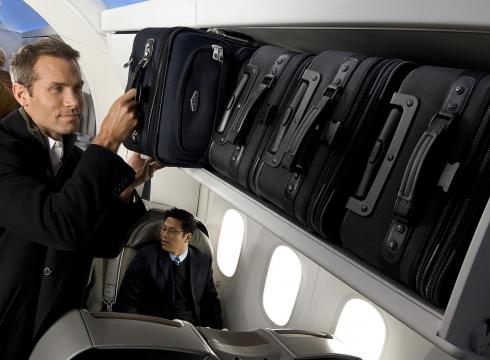
Place your bag under your seat. Overhead compartment availability and regulations are just too wildly different to be trusted, in my experience. Your absolute best move, your most powerful ally, is your under-seat bag.
Even if you do all your homework and you have an overhead bag that totally fits, you still might find yourself on an over-booked flight with zero room left in the overhead bins. Unfortunately this problem cannot be solved by just arriving super early and being the first person on the plane, because layovers are common and you never know what situation a delay can put you in. Also the boarding procedures may be in rows or groups.
So, take advantage of the under-seat “personal item” option. It is by far the most liberal and unregulated option. Yet with the right packing method and the perfect size camera bag, you can easily fit two camera bodies, 2-3 medium or large lenses, a flash, and a laptop. Your absolute minimum set of equipment for getting the job done right, and it fits under your seat which is a space that no flight attendant will ever hassle you about.
- Extra seat(s) shall be requested and paid for in advance.
- The normal applicable free checked baggage allowance applies for every extra seat booked (EXST). For example, 1 passenger books 2 extra M-Class seats for comfort. The total checked baggage allowance for this passenger will be 3 x applicable free baggage allowance.
- If a seat is used to place items on (CBBG), these items may not weigh more than 46 kg per seat.
- Items placed on a seat should be adequately packed to prevent damage.
A Few Other Tips
Memory Cards
They belong in your pocket. Even as you go through security, they should not leave your sight. I put my card wallet in the same little bowl that you put keys. Luggage can get lost, bags can get stolen or damaged, but your memory cards should never, ever leave your possession. Losing them is losing your hard work, more so if you weren’t able to back up your images. Back your images up to the cloud if it is at all possible.
Register Your Gear Before Departure
The last thing you need is to pay taxes on gear you already own, make the time to call passed customs and complete the relevant paperwork.
Know The Airline Legalities and Policies
The biggest tip here is that because airlines are not able nor willing to offer insurance for expensive gear, they cannot force you to check equipment of extremely high value. Notice, however, that I didn’t say “force you to check a bag of equipment.” They can still force you to check the bag. Unfortunately, this may mean, worst case scenario, that you literally empty your overhead bag and wear your equipment around your neck onto the plane.
It is a known fact that airlines will not cover the losses of photographic equipment if placed in the hold: cameras, lenses and electronics are NOT covered by the airline’s lost or damaged luggage policy, so if at all possible photographic equipment (and computers) should be placed in your carry-on baggage and NOT in your checked baggage. In fact most airlines won’t compensate you for anything that they lose or damage in your checked baggage except for clothing.
Be Polite and Professional
Contrary to popular belief, “making a scene” isn’t never the best option. Depending on the mood an employee is in, complaining loudly might only dig your grave deeper. As long as you can, be professional and polite even in extremely frustrating situations. I totally understand the “hold your ground / let them know how upset you are” mentality, but sometimes friendly compromise and a personal connection can make a world of difference! If you can speak their language, do so, it has helped me many a time to fly under the radar when I have been overweight with my hand luggage.
Contact The Airline
Email the airline and see if you can get it in writing that you will be carrying photography gear, the size meets their requirement, however the weight doesn’t, can they assist you?
If you have any questions or comments feel free to post in the comments below. I would really like to hear how my fellow photographers manage their air travel affairs, and the experiences they have had, both good and bad.




saa doesnt check hand luggage weight the only place your hand luggage might get weighed but probably doesn’t is at the scanners
Thanks for the heads up Marc!
Thank you sharing useful information for us. i always read your blog.
Thank you for your kinds words and for your support!