

Which Film Should You Buy?
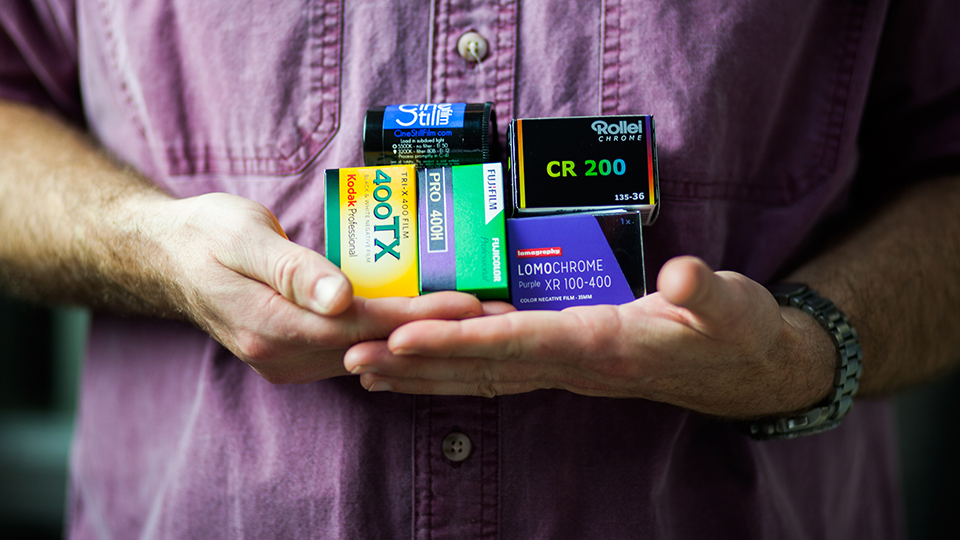
By Eric Reichbaum
Maybe you’re an amateur digital photographer, or a young professional photographer who got into photography after darkrooms were removed from your school’s classroom, and you’re interested in shooting film but you don’t know where to begin. This guide will help you navigate your way through the multitude of options out there. While there aren’t nearly as many types or sizes of film as there were in the past, there are still enough to make choosing your film a daunting task.
Let’s take a look at your choices and, hopefully, help you narrow the field down to a few good choices that will work for your needs.
Roll and sheet films are available in three different options: black-and-white, colour negative, and colour transparency.
Black-and-White Negative Film
If you’re brand new to film photography, shooting black-and-white is a good place to start for a few reasons. It is generally more forgiving, so if you miss your exposure, you’ll have a better chance of pulling back shadows or highlights than you would with colour film. Another reason that B&W is a good starting point is that it is much easier to develop at home, an option that is not only rewarding and fun, but will also afford you more control over the look of your photos and save you money if you shoot a lot.
A common black-and-white film is Kodak’s Tri-X, a 400-speed film noted for its fine, yet distinct grain quality, high sharpness, and wide exposure latitude. Tri-X was introduced in 1954 and has long been a choice of professional journalists and documentarians. Think of the most well-known images from the Vietnam War, and photos of celebrities like Muhammad Ali and Johnny Cash; chances are the images you’re picturing were all captured on Tri-X film.
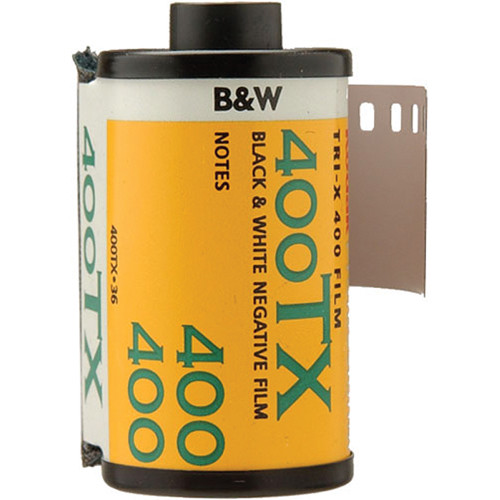
Similar to Tri-X 400 is Tri-X 320, or TXP, which is now only available in sheet film sizes. Compared to Tri-X 400, this film has smooth tonal gradations, a bit of a narrower exposure latitude, and improved highlight separation. Depending on the format you will be working with, both TX 400 and TXP 320 are classics, albeit quite different from one another.
Also popular is Kodak’s T-Max, which is available in 100 and 400 speeds, in both rolls and sheets, and has even finer grain than Tri-X. Kodak claims that T-Max 400 is the sharpest and finest grain stock of any 400 speed black-and-white film, and that T-Max 100 is the finest grain 100 speed black-and-white film. This is due to the T-GRAIN emulsion structure, which is a bit more homogenous and clean-looking than the classic grain profile of Tri-X. T-Max films are also especially well-suited for scanning, due to the less-apparent grain.
Ilford’s HP5 Plus and FP4 Plus are other good options for general black-and-white shooting. HP5 is a 400-speed film that exhibits medium contrast, extended shadow detail, and a wide exposure latitude that permits rating this film up to EI 3200. FP4 is the slower, finer-grained option that exhibits a fine grain structure with high sharpness and acutance, making it a fine choice for enlargements.
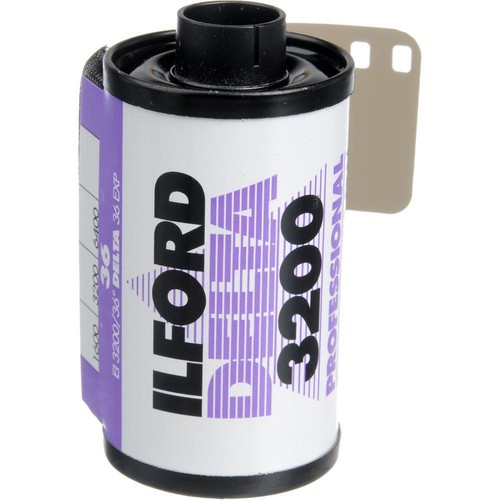
If you’re looking to shoot a higher-speed film, try Ilford Delta 3200, which is great for shooting in low-light conditions. Delta is known for its wide latitude, making it a forgiving film if you over- or underexpose your shots, and is responsive to pushing or pulling when developing. Delta is also available in 100 and 400 speeds, both of which use core-shell crystal technology for extremely fine grain and high sharpness. Ilford’s chromogenic XP2 Super is a unique 400-speed black-and-white film that is processed using the same C-41 chemistry for colour negative films, meaning you can have it developed at most one-hour film labs. Also available from Ilford are Pan F Plus, a slow ISO 50 film with extremely fine grain, and SFX, a 200-speed film with added sensitivity to red light to give an infrared film look.
Also worth noting are Fujifilm’s Neopan 100 Acros, an orthopanchromatic film that is ideal for long exposures; Rollei’s RPX 25, a low-speed film with a transparent base that is great for scanning; Rollei Infrared 400, the sole true remaining infrared film available; and Adox’s variety of black-and-white films, which tend to be slower, high-resolution options that support reversal processing to make black-and-white slides.
Colour Negative Film
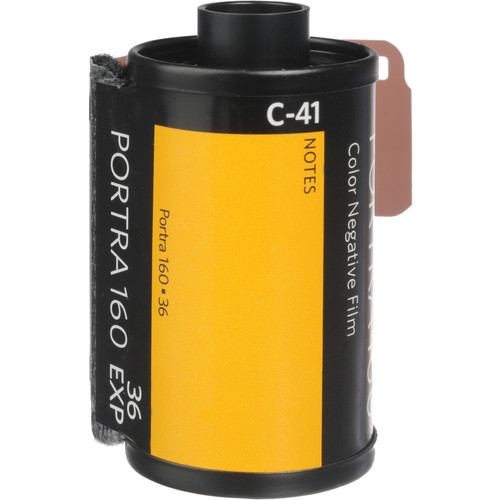
If you prefer colour over monochrome images, or if you want to shoot both, there are a number of great options available. A popular choice is the Kodak Portra series, a relatively new film, being introduced in 1998. It has gone through a few different updates and upgrades before landing at today’s current stock, which is available in speeds of ISO 160, 400, and 800. As the name suggests, it is ideal for portraits, thanks to its naturally reproduced skin tones, realistic colour saturation, high sharpness, and very fine grain. Portra’s T-GRAIN emulsion and low contrast make it ideal for scanning applications.
If Portra’s colours prove too muted for your style, consider Kodak Ektar, a 100-speed film known for its exceptional sharpness, vivid and highly saturated colours, and very fine grain. Another option is Fujifilm’s Fujicolor PRO 400H, a film that is best suited for fashion, portraits, and other work where accurate colour reproduction is essential. Kodak Gold and GC/UltraMax have long been popular films for less discerning, more casual applications, and remain good options for those looking for an affordable film with fine grain and rich colour saturation.
Colour Transparency Film
Colour transparency film, also known as colour reversal, chrome, or slide film, produces a positive instead of a negative and has several distinctions compared to negative film. The most obvious is that when you get your film back, it will be a correct, positive image rather than a negative image shrouded by a colour mask. This lets you project your slides or view them more easily, but does complicate things if you are looking to do any traditional printing from slides nowadays. On the plus side, slides are very good for scanning and tend to have vibrant, punchy colours that are suitable for landscape and nature photography. One con to transparency film, however, is that it inherently has a narrower exposure latitude than virtually any negative film, meaning your exposures really have to be precise to get usable results.
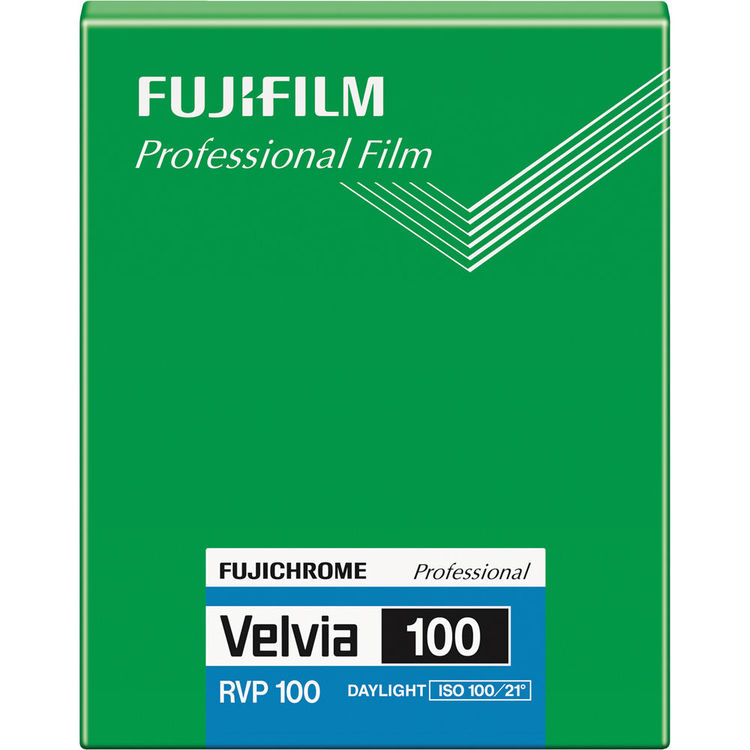
Once very common among pros and amateurs alike, slide film has slowly faded into obscurity. Kodachrome was discontinued in 2009, Ektachrome products ceased to exist around 2013, and now there are only Fujifilm’s Provia 100F, Velvia 50, and Velvia 100 left from the major film brands, with a few other transparency films from brands such as Agfa, Rollei, and Lomography. As with all slide film, both Provia and Velvia offer very little leeway in terms of exposure, although Provia is slightly more forgiving. Provia is less saturated than Velvia, and lends itself better to long exposures, thanks to its relatively higher reciprocity. Velvia produces highly saturated transparencies often appreciated by landscape photographers. Additionally, both Provia and Velvia are the last remaining transparency films available in sheets for large format photographers.
Experimental Film
Lastly, there are some less traditional films on the market now that lend themselves well to experimentation. Lomography has a wide variety of these oddball films, such as LomoChrome Purple a highly saturated film with a purple hue, and Redscale, a unique reverse-rolled film that produces images with a distinct red hue. Lomography also offers some of the only 110 cartridge film still available today. Two films from CineStill bring the look of cinematic motion pictures to still photography with 50Daylight Xpro, an ISO 50 daylight-balanced colour negative film, and 800Tungsten Xpro, an ISO 800 tungsten-balanced film, both with the rem-jet anti-halation layer pre-removed, allowing for normal C-41 processing. Adox’ Color Implosion is another experimental film that produces vibrant red tones with a very prominent grain structure.
Instant Film
Instant film can be broken down into three categories: instax film for Fujifilm instax Cameras, Fujifilm peel-apart film for Polaroid cameras, and Impossible Project instant film for Polaroid cameras.

Let’s start with what most people think of when they think of instant film: Polaroids. Unfortunately, Polaroid no longer exists as we once knew it, and the company stopped making film years ago. Luckily for photographers, a company called the Impossible Project started up and began making its own film for type 600, SX-70, and Image/Spectra Polaroid cameras. In addition to standard white frames, they also have unique options such as Round Frames and animal print Skins Edition frames.
Next is Fujifilm’s instax films designed especially for the instax cameras. There are two types: instax mini, and instax Wide. These are similar to the original Polaroid instant film and the current Impossible Project offerings.
Last, but not least, is Fujifilm’s Professional FP-100C (colour) and FP-3000B (black-and-white) peel-apart films. The FP-3000B has been discontinued, unfortunately, but is still available until current stock runs out. These two films are made for cameras that accept instant film with a photo size of 85 x 108mm, such as the Polaroid Automatic Land Cameras, and those provided or fitted with a compatible back.

Whether you’re a seasoned digital photographer looking for a new way to capture images, or a student shooting film as part of a class requirement, film photography is sure to spark a fire in your photography. If nothing else, it will cause you to slow down and appreciate each frame you capture. Though it may take some time to go through the plethora of film mentioned above, eventually you’ll find your favourite, go-to film.
I buy most of my film at B&H in New York, as it is much more affordable than locally, it sometimes can be even more affordable if a few film shooters buy in bulk together to reduce the shipping expenses.
Although the selection of film options are certainly far from what it used to be, Orms does stock a reasonable selection, including:
- Ilford Delta 100 (available in 35mm and 120)
- Ilford Delta 400 (available in 35mm and 120)
- Ilford FP 4 Plus (available in 35mm and 120)
- Ilford HP 5 Plus (available in 35mm and 120)
- Ilford XP 2 Super 400
- Ilford PANF 50 Plus (120)
- Kodak Portra 160 (available in 35mm and 120)
- Kodak Portra 400 (available in 35mm and 120)
- Kodak TX 400 (available in 35mm and 120)
- Kodak T-MAX 100 (available in 35mm and 120)
- Kodak TX 100 (available in 35mm and 120)
- Kodak Ektar 100
- Fujifilm Superia X-Tra 400
NOTE: Some of these aren’t loaded on the website, they do usually have in stock. Please phone Orms Cape Town on 021 469 1977 for more information.



0 Comments